
Paver Walkway Installation in Rosemead, CA
Rosemead Paver Pros designs and installs paver sidewalks and walkways for homeowners throughout Rosemead and the surrounding San Gabriel Valley. Every walkway is built for safe, even footing and lasting curb appeal.
20+
YEARS OF EXPERIENCE
450+
PROJECTS COMPLETED
4.9/5
AVERAGE CUSTOMER RATING
4hr
AVERAGE REPONSE TIME
Everything to Know Before Installing a Paver Sidewalk
A paver sidewalk is a durable, interlocking stone pathway built from individual paver stones rather than a single continuous concrete pour, giving homeowners a walkway that's both more resilient and more visually appealing than standard concrete. Unlike a poured slab, which cracks as a single rigid unit when the ground beneath it shifts, a paver walkway is made up of many individual pieces that can flex slightly with natural ground movement, which is part of why they tend to hold up so well over time.
Homeowners typically consider a new paver sidewalk when their existing concrete path has become cracked, uneven, or heaved by tree roots, creating a trip hazard that's only going to get worse the longer it's left alone. Others pursue a paver sidewalk simply because they want a more attractive, upscale entrance to their home, especially when other exterior upgrades like landscaping or a new driveway have already been completed and the old concrete walkway now looks noticeably out of place by comparison.
Once completed, a paver sidewalk offers a number of practical benefits beyond curb appeal. Individual stones can be lifted and reset if damage occurs, meaning future repairs are typically faster, cheaper, and less invasive than repairing a section of concrete. The finished surface also provides better traction underfoot, particularly important for elderly family members or homes with young children, and the wide range of available colors and patterns allows the walkway to be tailored to match the specific style of the home.
Signs It's Time for a New Paver Sidewalk
Homeowners with a cracked, sunken, or root heaved concrete walkway are the most common candidates for a paver sidewalk replacement, particularly when the damage has created a trip hazard for family members or visitors. It's also a popular addition for homeowners connecting separate areas of their property, such as a path from the driveway to the front door or a walkway leading to a side yard or backyard entrance. The ideal time to install is whenever the existing hazard is identified, since walkway safety issues tend to worsen the longer they're left unaddressed.
Choosing not to repair a damaged walkway carries real risk, since uneven surfaces are one of the more common causes of trip and fall injuries around a home. Beyond safety, a cracked or deteriorating walkway can also make an otherwise well maintained property look neglected from the street, which matters for both everyday pride of ownership and eventual resale value.
How We Install Your Paver Sidewalk, Step by Step
Every paver sidewalk installation begins with an on-site consultation where we assess the existing path, take precise measurements, and discuss paver color and pattern options that complement your home's exterior. If an existing concrete walkway is being replaced, we remove and haul away the old surface before any new work begins.
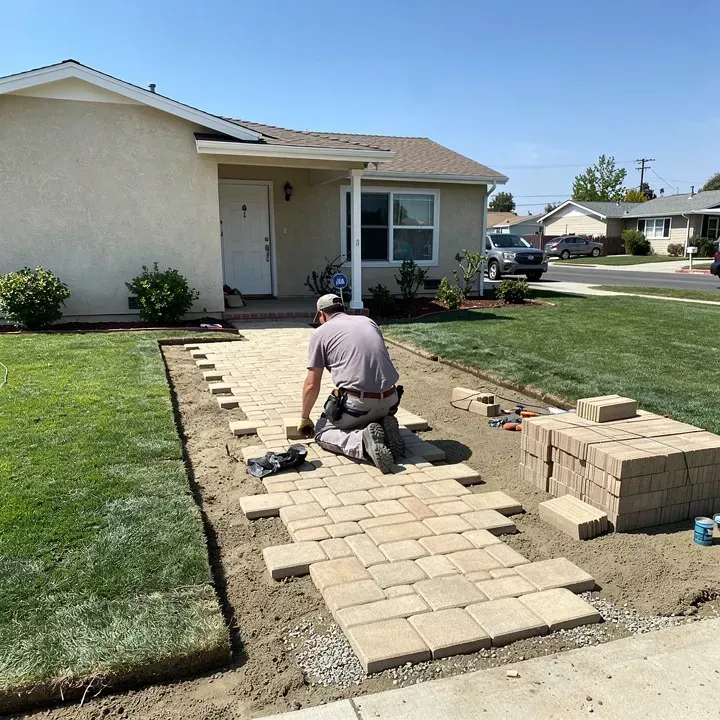
From there, we excavate to the proper depth along the entire pathway and install a compacted base layer suited to foot traffic. Pavers are then set over a sand bedding layer in the chosen pattern, with careful attention paid to consistent width and a smooth, even walking surface free of trip hazards. Edges are cut precisely around any curves, steps, or landscaping features along the path.
Once all pavers are set, we compact the surface again and sweep polymeric sand into the joints, activating it with water so it locks the stones firmly in place. A thorough cleanup completes the project, leaving a walkway that's ready to use immediately.
Understanding Paver Sidewalk Pricing
The cost of a paver sidewalk is primarily driven by the total length and width of the pathway, since sidewalks are typically priced based on a combination of linear footage and total square footage rather than square footage alone. A short, straight path from a driveway to a front door will naturally cost less than a longer, winding walkway that connects multiple areas of a property, simply because more material and labor are required to complete it.
Design complexity plays a significant role in the final price as well. A straightforward rectangular path is the most economical option, while curved layouts, multiple paver colors used together, decorative borders, or contrasting accent bands all require additional precision cutting and installation time, which increases labor cost accordingly. Homeowners who want a walkway that makes a real design statement should expect this added detail to be reflected in the estimate.
Site conditions at the time of installation also factor heavily into the total cost. If an existing concrete walkway needs to be removed first, that demolition and debris haul away adds to the overall project price. Obstacles like established tree roots, existing landscaping beds, irrigation lines, or utility access points near the path can also require extra care and time to work around properly, particularly if root pruning or a root barrier installation is needed to prevent future damage.
Finally, the grade of paver material selected has a direct impact on pricing. Standard concrete pavers offer a budget friendly option that still delivers excellent durability, while premium textured or natural stone finishes come at a higher price point but offer a more distinctive, upscale look. During your free on-site consultation, we walk through all of these factors together and provide a detailed, itemized estimate so you understand exactly what's driving the cost of your specific project before any work begins.
Frequently Asked Questions
Will a new paver sidewalk fix the trip hazard from my old cracked walkway?
Yes, replacing a cracked or heaved concrete walkway with a properly installed paver sidewalk eliminates the uneven surfaces that create trip hazards in the first place. Because pavers are installed over a properly compacted base and can shift slightly without cracking, the resulting surface stays smoother and more stable over time compared to a rigid concrete slab.
Can you work around tree roots that are causing my current walkway to lift?
Yes, we regularly deal with tree root interference during sidewalk replacements. Depending on the severity, we may root prune around the affected area, install a root barrier to prevent future lifting, or adjust the pathway design slightly to route around a particularly large root system while still keeping the walkway functional and attractive.
How wide should my new paver sidewalk be?
Most residential sidewalks range between three and four feet wide, which comfortably accommodates one person walking or two people passing each other. Wider paths may be appropriate for main entryways or high traffic areas, and we'll help you determine the right width for your specific layout during the consultation.
Do paver sidewalks require much maintenance?
Paver sidewalks require relatively minimal maintenance compared to concrete, mainly occasional sweeping, weed prevention in the joints, and periodic sealing every few years to maintain color and stain resistance. Because individual pavers can be lifted and reset if needed, any future repairs are typically quicker and less invasive than repairing a cracked concrete path.
Ready to Upgrade Your Outdoor Space?
Your backyard has more potential than it's currently living up to. Whether that means a new paver patio, a driveway that finally matches the rest of your home, or a cozy fire pit for cool evenings with family, Rosemead Paver Pros is ready to bring it to life. Reach out today for a free, no obligation estimate and see why homeowners throughout Rosemead and the San Gabriel Valley trust us with their hardscape projects.


Contact
(626) 548-4496
Mon–Sun: 7am–6pm
Rosemead, CA
About Us
Rosemead Paver Pros is a locally owned and operated hardscape contractor serving homeowners throughout Rosemead and the greater San Gabriel Valley. With years of hands on experience, our team is committed to delivering durable, quality craftsmanship backed by honest communication and a genuine care for every property we work on. From the first estimate to the final walkthrough, we treat each project like it's our own home.
© Copyright 2026 Rosemead Paver Pros. All rights reserved.
© Copyright 2026 Rosemead Paver Pros.
All rights reserved.